 Hoffman Water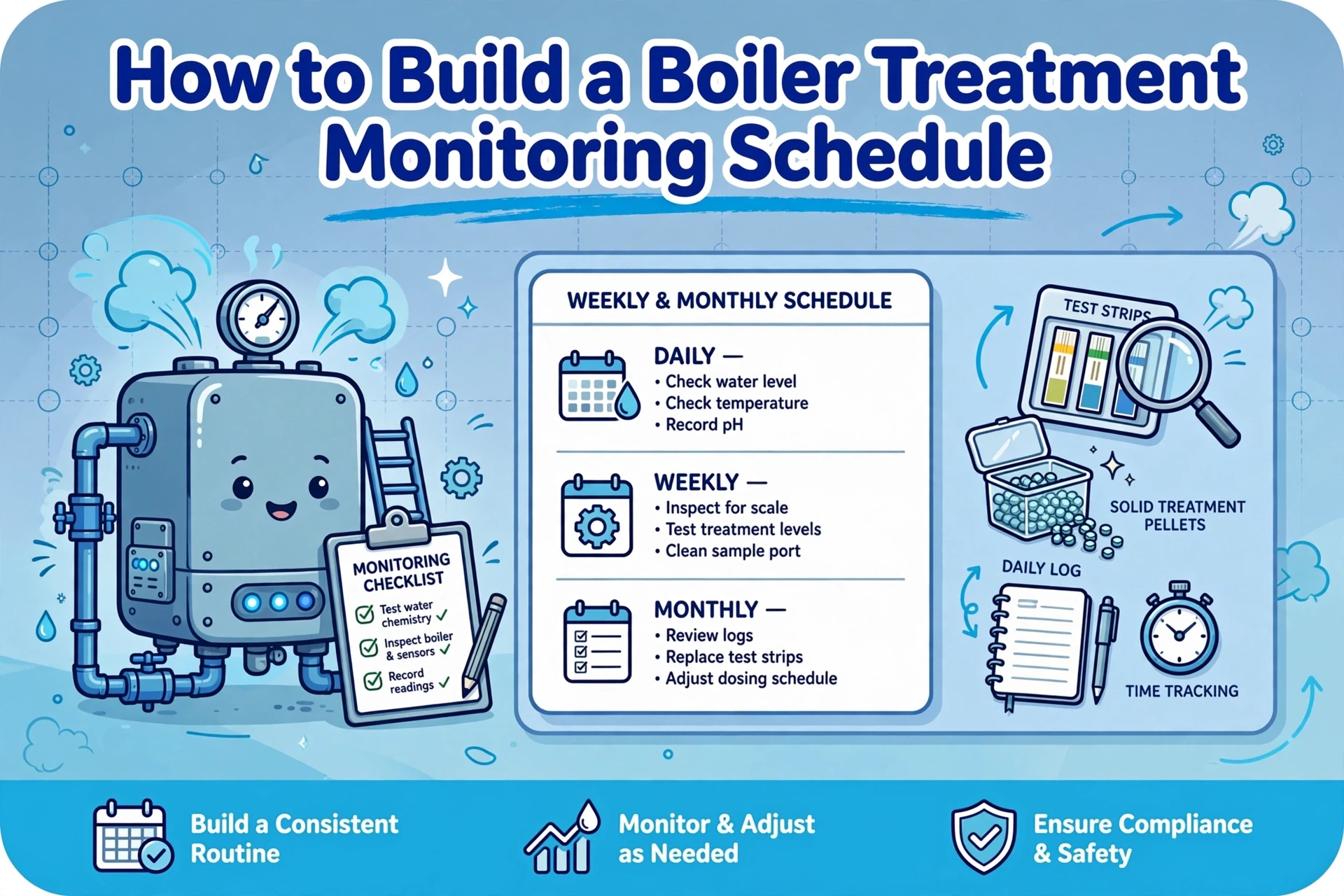
Quick Summary: Build a boiler treatment monitoring schedule by matching test frequency to your boiler's pressure and treatment program, then assigning daily checks for conductivity, sulfite, pH, and hardness, with weekly and monthly reviews for condensate pH, iron, and lab panels. Log each reading with sample point, context, and the response taken, so a rising conductivity trend points to a cause instead of a guess. Escalate any result outside confirmed limits or a two-week trend in one direction. Hoffman Water builds these schedules for Ohio facilities, setting limits, cadence, and logs around actual boiler loads.
When a boiler conductivity reading starts climbing between operator rounds, your boiler treatment monitoring schedule should tell you why. Does the change track with load, makeup water quality, or a treatment-control problem? Without a fixed cadence, you guess. This guide gives you a practical schedule: what to test, how often, how to sample, and how to trend results. The limits shown are typical, but site-specific values must be confirmed with your water treater or engineer.
Step 1: Set the Schedule Around Your Boiler and Treatment Program
Boiler treatment monitoring isn't one-size-fits-all. A low-pressure steam boiler running a solid chemistry program needs fewer checks than a high-pressure unit feeding a turbine. Start with three inputs: operating pressure, steam purity requirements, and how your treatment is dosed. High-pressure and condensate-return systems call for daily tests; most low-pressure units can run on a weekly core set with monthly review. Match the cadence to blowdown control, hardness risk, and oxygen scavenger demand - and confirm site limits with your water treater before you lock the schedule in.

Building the schedule around a well-designed boiler treatment system keeps the work load reasonable and the data useful.
Step 2: Assign Daily, Weekly, and Monthly Chemistry Checks
A schedule only works if someone owns each test. Match the test frequency to how fast the parameter can drift, then put names and times on the task.
Daily checks while the boiler is in service
Run these every shift, and log each result with the operator's initials:
- Conductivity or dissolved solids, to steer blowdown
- Sulfite or other oxygen scavenger residual
- pH of the boiler water
- Hardness on the feedwater and condensate return
- Pump and day tank levels for your chemical feed equipment
Weekly and monthly review points
Weekly, verify condensate pH and iron, check feed rates against actual water use, and calibrate test kits. Monthly, pull a representative sample for lab-level review of phosphate, alkalinity, and chloride, then trend results against site-specific limits. If in-house time is tight, a boiler water treatment partner can handle sampling and review.
Confirm limits and test frequency with your water treater or boiler manufacturer before locking the schedule.

Step 3: Build a Log That Makes Results Actionable
Record the reading, sample context, and response
A number alone tells you little. Record each reading with the sample point, the water temperature, and any unusual conditions that day, like a load swing or new chemical drum. Then note what you did about it.
| Field | Example entry | Why it matters |
|---|---|---|
| Reading | Conductivity 3,800 µS/cm | The raw value |
| Sample point | Blowdown line, 2 pm | Confirms a fair sample |
| Context | Load at 80%, new drum opened | Explains the spike |
| Response | Increased blowdown, retested 4 pm | Closes the loop |
This pattern turns a filing exercise into a decision record. When conductivity drifts upward over weeks, you can point to cause and fix, not guess. An engineer reviewing your boiler water treatment program can act on a log like this in minutes.
Step 4: Sample Safely, Review Trends, and Escalate Exceptions
Pull samples from a cooled, flowing line and flush first, so the result reflects the boiler rather than the sample valve. Follow safe-blowdown practice: PPE, steady valve sequence, no standing in front of discharge.
Record every reading in your log, then compare it to the last few weeks. A single high conductivity reading may be a bad sample. Three readings trending the same way are a real problem.
Escalation rule: any result outside your confirmed limits, or a two-week trend in one direction, triggers a corrective action and a note in the log.
Need step-by-step test methods? See our guide on testing boiler water before problems escalate.
Want a monitoring schedule built around your actual boiler loads? Hoffman Water engineers boiler treatment programs for Ohio facilities. Contact us to set limits, cadence, and logs that fit your plant.
Frequently Asked Questions
Q1: What should be tested daily, weekly, and monthly in a boiler water treatment schedule?
Daily: conductivity, sulfite, pH. Weekly: hardness, phosphate, alkalinity. Monthly: iron, full panel review, trend check against limits set by your water treatment professional.
Q2: What boiler water chemistry parameters belong in a monitoring log?
Log date, time, tester, boiler pressure, conductivity, pH, sulfite or oxygen scavenger residual, hardness, alkalinity, inhibitor level, and blowdown actions. Trends matter more than single readings.
Q3: How often should boiler water be tested to prevent scale and corrosion?
Test softener hardness and feedwater daily; boiler water at least once per shift or daily. Confirm frequency with your chemical supplier, since operating pressure and load change the safe interval.
Conclusion
A solid boiler treatment monitoring schedule sets clear test frequencies, uses representative samples, and logs trends you actually review. Confirm every limit and interval against your boiler's specs and water conditions. For engineer-led support across Ohio, Hoffman Water's boiler water treatment services team can tailor the plan.