 Hoffman Water
Quick Summary: Boiler water testing must start with consistent sampling-makeup water, softener outlet, feedwater, boiler water, condensate, and blowdown-to catch issues like softener breakthrough or rising conductivity before they cause tube leaks or poor steam quality. Focus on four key tests-conductivity, pH, hardness, and alkalinity-since spikes in conductivity or hardness signal problems like scale buildup or treatment failure, often before equipment fails. If readings are off, verify the sample first, then adjust blowdown or treatment only after confirming trends, never based on a single test. Partner with an engineer-led provider like Hoffman Water for trend analysis and system-level fixes, especially when makeup water or condensate shifts occur.
Clear water can hide a softener breakthrough, rising condensate conductivity, or a low sulfite reserve. Those issues can lead to tube leaks and poor steam quality fast. This guide makes boiler water testing practical: what to test, where to take samples, and how to spot bad trends. Built on real plant troubleshooting, it helps teams use boiler water testing results before damage starts.
Step 1: Sample Every Point That Can Explain the Change
Use a Consistent Sampling Sequence
Start boiler water testing at the same points and in the same order each round:
- Makeup water
- Softener outlet
- Feedwater
- Boiler water
- Condensate return
- Blowdown
Record time, load, and chemical-feed status. The DOE notes that changing makeup water and condensate return can change needed blowdown rates. Its guidance supports routine checks across the system.
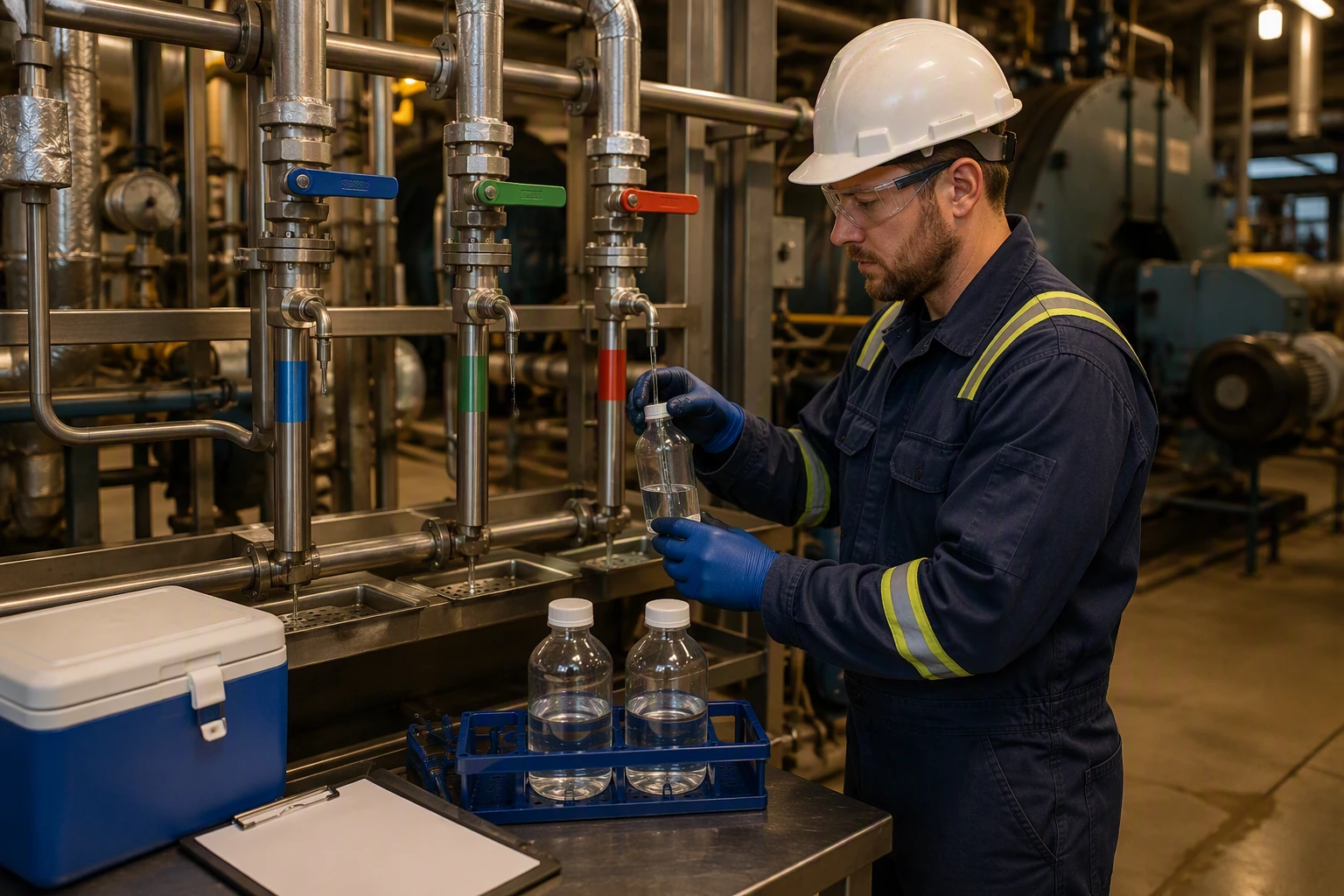
Warning: Never pull a hot sample without a working sample cooler and site safety steps.
Match Each Sample to Its Diagnostic Question
| Sample point | Question it answers |
|---|---|
| Makeup water | Did source-water quality shift? |
| Softener outlet | Is hardness leaking through? |
| Feedwater | Is treatment reaching the boiler? |
| Condensate | Did process contamination enter? |
| Boiler water | Are solids concentrating too high? |
A single boiler-water result cannot show where the change began.
Also Read: 5 Boiler Treatment Systems for Manufacturing Facilities
Step 2: Test the Indicators That Move Before Equipment Fails
Start With Conductivity, pH, Hardness, and Alkalinity
Check these four values at each scheduled sample. Conductivity shows dissolved-solid buildup. Hardness warns of softener slip and scale risk. pH and alkalinity show whether water chemistry is drifting.
| Test | Early warning |
|---|---|
| Conductivity | Blowdown or makeup change |
| Hardness | Softener breakthrough |
| pH and alkalinity | Treatment imbalance |
The DOE notes that conductivity rises with dissolved ions and helps control blowdown. See its guidance.

Confirm Treatment Residuals and Corrosion Signals
Test the treatment residual your program calls for. Also trend dissolved oxygen, iron, and condensate pH.
- A falling residual can mean underfeed.
- Rising iron can point to active corrosion.
- Oxygen spikes can signal deaerator or pump issues.
Do not chase one odd reading. Retest, compare trends, and call a qualified provider for a sudden shift.
Also Read: Boiler Water Treatment vs Filtration: Which Protects Steam Systems?
Step 3: Turn an Out-of-Range Result Into a Safe Response
Verify Before You Adjust
Do not change feed rates from one test. Re-sample from the correct cooled sample point, check reagent dates, and compare the result with your log and controller reading.
Warning: Follow site lockout, sampling, and chemical-handling rules. Never open a hot, pressurized sample line.
Escalate by Risk, Not Just by Number
| Finding | Safe first response |
|---|---|
| High conductivity | Verify sample, then review blowdown control |
| Low treatment residual | Check pump, product, and feed signal |
| Oxygen or pH shift | Call your treatment provider promptly |
High dissolved solids can cause foaming, carryover, deposits, and equipment damage, according to the U.S. Department of Energy. Contact Hoffman Water for repeated excursions, sharp trend changes, or signs of corrosion. Do not chase readings with blind chemical additions.
Also Read: How to Prevent Scale in Industrial Boiler Water Systems
Step 4: Choose the Right Testing and Monitoring Partner
Leading Provider Types to Evaluate
Choose a partner that can test water, read trends, and change the treatment plan. The DOE advises using a water treatment specialist and checking boiler chemistry routinely. DOE guidance
| Provider type | Best fit |
|---|---|
| Test-only lab | Independent sample results |
| Chemical supplier | Basic treatment support |
| Engineer-led provider | Complex systems and root-cause work |
Hoffman Water fits the third group, with onsite support and system engineering.
Ask for Evidence Before You Buy
Ask for:
- Sample reports with trends and action limits
- Clear test frequency and emergency response terms
- Proof they review makeup water, condensate, and blowdown together
Do not accept a program based on one test-kit reading. Demand a written response plan for abnormal results.
Stop reacting to bad readings. Hoffman Water can review boiler trends, engineer treatment, and provide fast Ohio support before scale or corrosion causes downtime.
Frequently Asked Questions
Q1: Which leading companies provide boiler water testing and monitoring?
Hoffman Water provides engineer-led testing, monitoring, and treatment support for Ohio facilities. ChemREADY, Trionetics, and Environmental Water Ltd also serve industrial water-treatment needs.
Q2: How often should I test boiler water?
Test key control points daily or each shift for high-pressure or critical boilers. Review trends weekly, and increase checks after makeup-water changes, blowdown adjustments, or treatment-feed issues.
Q3: What should I do after an abnormal test result?
Retest from a clean, cooled sample point. Check chemical feed and blowdown settings. Do not make large dose changes from one result. Call a qualified provider if the trend persists.
Conclusion
Test representative samples, trend results, and act on changes early. Proper blowdown and routine chemistry checks help prevent deposits and carryover, as the U.S. Department of Energy notes.