 Hoffman Water
Quick Summary: Boiler corrosion control starts with diagnosing the root cause, not just adding more chemicals. Match the damage pattern to its driver, such as oxygen pitting from poor deaeration or caustic gouging under deposits, then fix the mechanical issue first. Remove dissolved oxygen with heat and deaeration before using scavengers, and stabilize pH to protect condensate lines. Track chemistry trends and inspect annually to catch problems early, as steady monitoring beats reactive fixes.
A boiler tube can develop deep oxygen pits even when the feedwater looks clear and steam output stays normal. By then, the damage is done. Effective boiler corrosion control means linking each failure mode to its source, checking the right chemistry, and acting before leaks start. This guide walks through that workflow step by step, drawn from years of treating boilers in manufacturing, food processing, and commercial facilities across Ohio.
Step 1: Find the Corrosion Driver Before Changing the Chemical Dose
Boiler corrosion control starts with a diagnosis, not a bigger dose. Most waterside attack traces back to four drivers: dissolved oxygen, low pH, caustic concentration under deposits, and stagnant water during shutdown. If you guess wrong, you pay for chemicals that never touch the real problem.
Match the Damage Pattern to the Likely Cause
The failure tells you the story. Oxygen pitting shows up as deep, sharp pits, often in the economizer inlet, usually tied to poor deaerator operation or bad shutdown layup. Caustic gouging forms smooth, scoop-shaped metal loss under porous deposits in hot waterwall zones. Thin-lipped bursts point to overheating and flow blockage instead.
| Damage pattern | Likely driver | First check |
|---|---|---|
| Deep, scattered pits | Dissolved oxygen, stagnant layup | Deaerator vent, shutdown practice |
| Smooth gouging under deposit | Caustic concentration | Deposit analysis, pH |
| General thinning, etching | Low pH or acidic attack | Feedwater pH, contamination |
Veolia's boiler failure handbook stresses that wrong diagnosis leads to wrong fixes, so the problem keeps returning. Engineers who treat this as a diagnostic step, not a dosing step, cut repeat tube failures - it's how teams like ours at Hoffman Water approach boiler corrosion control.
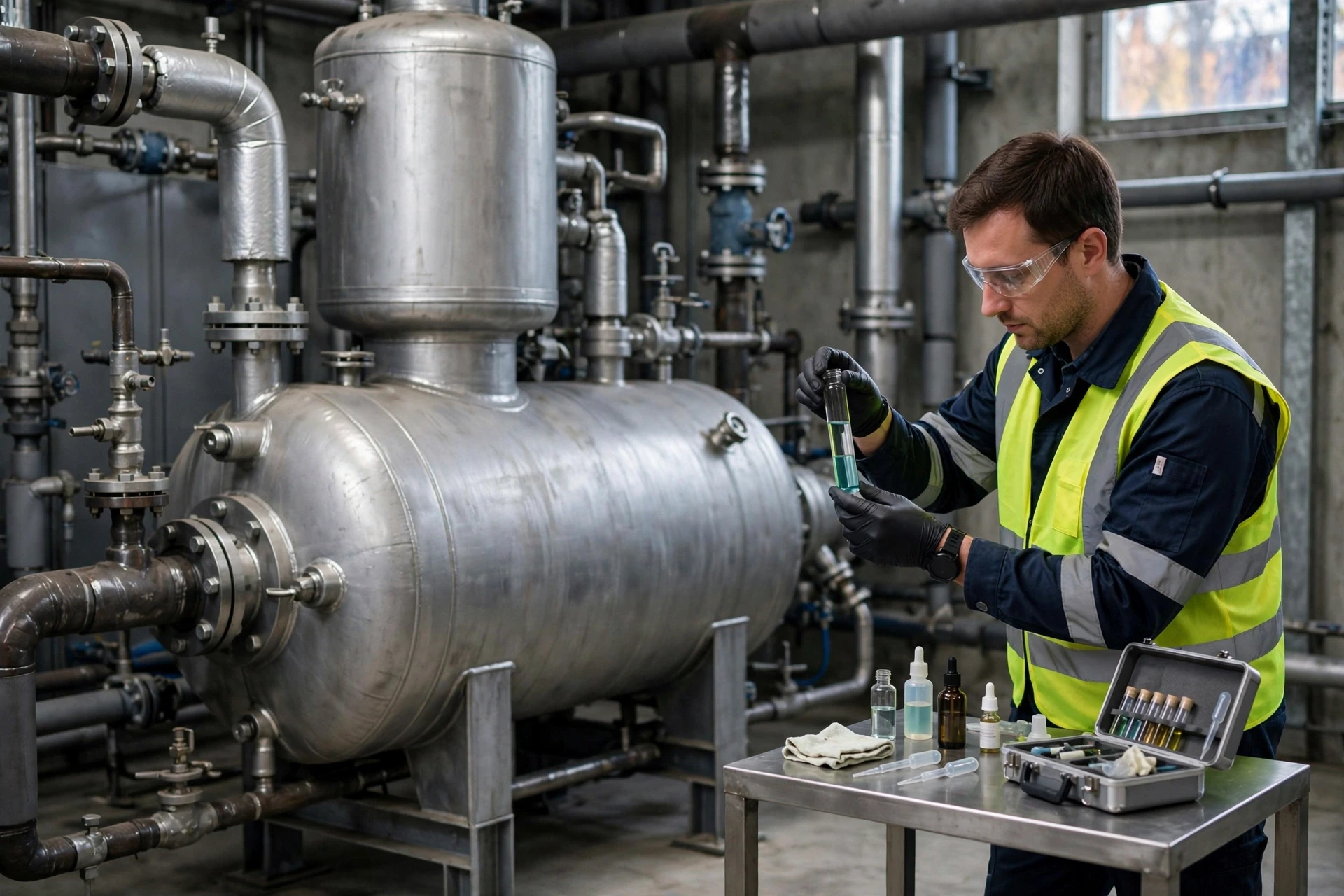
Step 2: Remove Dissolved Oxygen Before It Reaches the Boiler
Dissolved oxygen pits boiler tubes fast. Small, deep pits cause leaks even when total metal loss looks minor. Control it in the right order: mechanical first, chemical second.
- Heat the water. Oxygen solubility drops as temperature rises. Keep a heated feedwater tank at 180°F or higher; it can only get you to about 1 ppm of oxygen.
- Deaerate properly. A good deaerator sprays water into steam and vents the released gases, cutting oxygen by 97-98%. Watch the vent - too little venting means incomplete removal.
- Scavenge the rest. Feed an oxygen scavenger like sodium sulfite continuously, as far upstream as possible, so the reaction has time to finish.
Mechanical removal lowers chemical cost. Veolia's deaeration handbook is clear on this: scavengers supplement good deaeration, never replace it. ASME guidance targets less than 7 ppb of dissolved oxygen (QualiChem, PDF).
Also Read: 5 Boiler Treatment Systems for Manufacturing Facilities
Step 3: Stabilize pH, Condensate Return, and Deposit Control
Protect the Condensate and Boiler Surfaces Together
Carbon dioxide flashes off with your steam and re-dissolves in condensate as carbonic acid. Just 3 ppm of CO2 can drop condensate pH to 5.26, which eats carbon steel fast, per Chemical Engineering. Oxygen makes it worse, drilling localized pits through return lines.
Your fixes, in order:
- Raise condensate pH to 8.3 or higher with neutralizing amines like morpholine or cyclohexylamine.
- Test pH at multiple points, not just one sample station. Low-pH pockets hide downstream of steam traps.
- Add a filming amine or DEHA if oxygen pitting shows up on coupons. Amines alone don't stop oxygen attack.
- Track iron in the return. Rising iron means corrosion products are heading to your boiler tubes as insulating scale, per Veolia's water handbook.
Hoffman Water ties amine dosing to your actual steam distribution, so every return line gets covered.
Also Read: 7 Solid Chemistry Systems for Industrial Water Treatment
Step 4: Verify Control Through Sampling, Trends, and Inspection
Build a Corrosion Control Trend, Not a Single Test
One good test proves nothing. ASME's sampling guidance says poor monitoring leads to component failures, upsets, and unplanned outages. Track the same parameters on a fixed schedule:
- Test feedwater pH, hardness, and iron; boiler water sulfite, phosphate, and conductivity.
- Check condensate pH and iron - rising iron means return-line corrosion.
- Log results in one trend sheet and flag any drift for two weeks or more.
- Inspect internally at every annual outage for pitting, deposits, and oxygen gouging.
ASME's consensus practices set the standard for sample points and test frequency. Hoffman Water builds these trend reviews into its Ohio service visits.
Spot corrosion early, fix the cause, and keep your boilers running. Talk to the engineers at Hoffman Water for a free boiler water assessment.
Frequently Asked Questions
Q1: What are the most common causes of boiler corrosion in commercial systems?
Dissolved oxygen, low pH, carbonic acid from CO2 in condensate, and poor water chemistry control. Each leaves distinct symptoms, so test before treating.
Q2: How does dissolved oxygen cause boiler tube pitting?
Oxygen attacks bare metal at feedwater inlets and hot spots, carving small pits that deepen into leaks. A chemical oxygen scavenger plus a working deaerator prevents this.
Q3: What are the best ways to prevent boiler corrosion?
Control dissolved oxygen, keep feedwater pH in range, treat condensate lines, and monitor chemistry daily. Hoffman Water engineers custom programs for Ohio facilities.
Conclusion
Corrosion control comes down to linking each symptom to its source: check dissolved oxygen, pH, and condensate chemistry, then fix the mechanical cause first. Industry guidance confirms that steady monitoring beats reaction. Log results, act on trends, and protect your boiler.