 Hoffman Water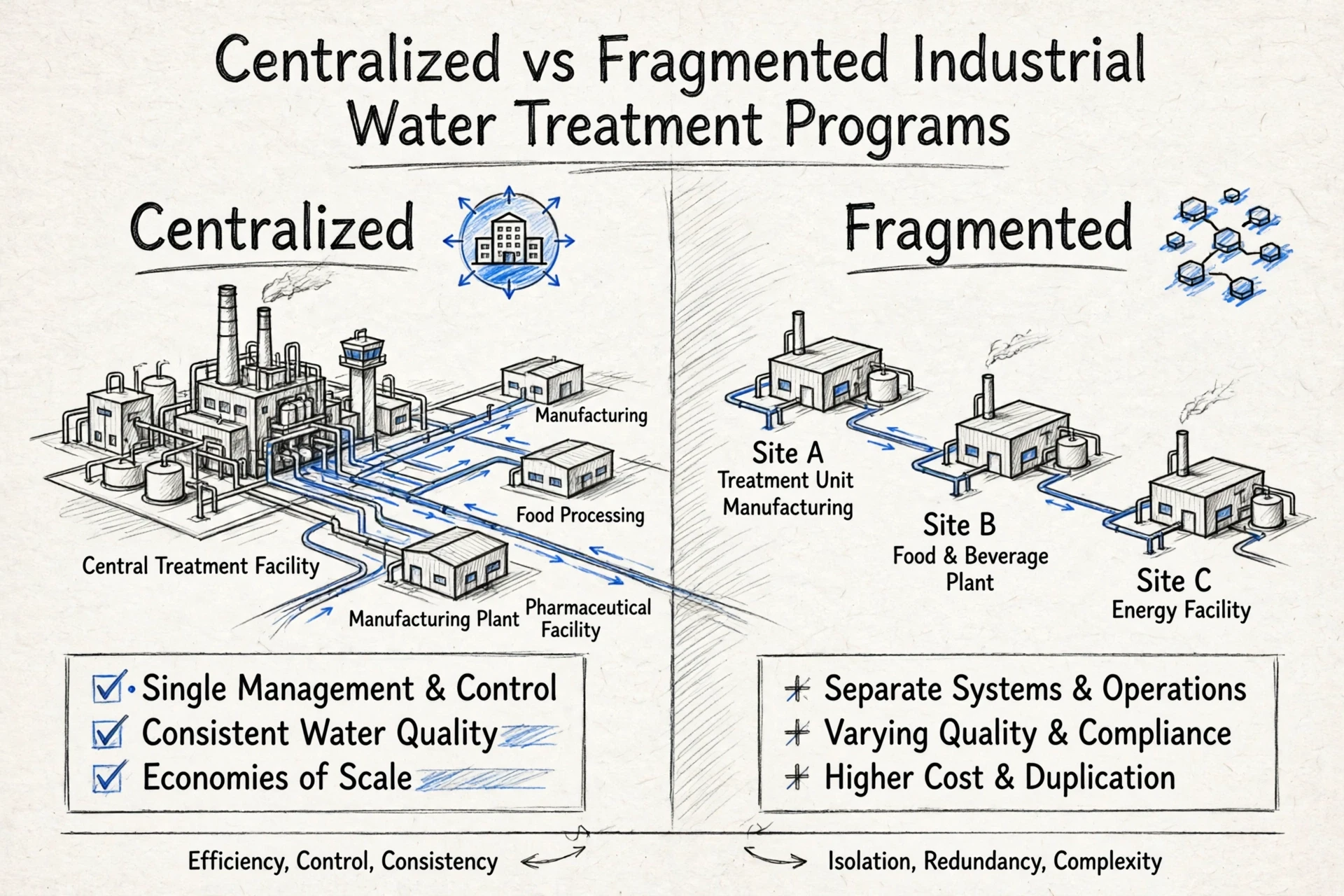
Quick Summary: A centralized water treatment program with one accountable provider beats fragmented vendor setups for most plants, since it eliminates coordination gaps and clearly assigns responsibility for results. Fragmented models still work for niche technical needs or when strong incumbent providers exist, but they force your team to manage handoffs and escalation. Choose based on your plant's scope and complexity, not vendor count, and always verify who signs off when performance slips.
When your boiler, cooling tower, and wastewater systems each use a different vendor, one problem at the boundary between systems can leave your team chasing three phone calls. A centralized program wins on coordination, though fragmented specialists still fit where a process demands deep niche expertise or independent oversight. This guide compares both models across accountability, coverage, and operating effort, so you can choose the industrial water solutions structure that protects your plant.
Centralized vs Fragmented Industrial Water Treatment: At a Glance
| Centralized industrial water treatment program | Fragmented industrial water treatment program | |
|---|---|---|
| Accountability | Can create a clearer lead contact; confirm written ownership and exclusions. | Responsibilities are divided; define handoffs and escalation routes. |
| System coordination | Designed to coordinate service and information across covered systems. | Coordination falls more heavily on the facility team. |
| Specialist depth | Depends on provider expertise and access to specialist partners. | Allows selection of niche providers for distinct technical needs. |
| Day-to-day workload | May reduce vendor scheduling and communication overhead. | Requires managing multiple contacts, schedules, and reports. |
| Best fit | Facilities seeking joined-up oversight across multiple water systems. | Facilities with distinct specialist requirements or existing strong providers. |
How Centralized industrial water treatment program and Fragmented industrial water treatment program Compare
Centralized industrial water treatment program
Here, one provider or one accountable program covers multiple water systems under a single contract. It suits facilities that want joined-up oversight and less vendor scheduling work. Many Ohio plants find this model pairs well with engineer-led industrial water solutions.
Key strengths
- One lead contact for service questions
- Coordinated reporting across covered systems
- Less day-to-day communication overhead
Fragmented industrial water treatment program
In this model, separate providers manage different systems, technologies, or services in one facility. It fits plants with niche technical needs or strong relationships already in place. The tradeoff: your team owns coordination, handoffs, and escalation routes.
Key strengths
- Freedom to pick specialists per system
- Keeps proven incumbent providers in place
- Lets niche expertise lead where it matters
Accountability and System Coordination
Fragmented programs blur responsibility. When the boiler vendor, the cooling tower vendor, and the wastewater vendor don't talk, problems fall in the gaps. ASHRAE Standard 188 makes this clear: someone must own the water management plan, and that owner answers for the results.
What One Accountable Program Should Include
- A named program owner with authority across every water system
- One written plan covering boilers, cooling towers, and wastewater together
- Shared testing data, so one vendor's chemistry problem doesn't hide in another's logbook
- Defined control limits, corrective actions, and annual plan review, as the standard's framework requires
- Single-point emergency response
Engineer-led providers like Hoffman Water build industrial water solutions this way: one accountable team, coordinated systems.
Also Read: Solid Chemistry vs Liquid Chemicals for Industrial Water Treatment
Coverage, Expertise, and Vendor Alternatives
Compare Scope Before Comparing Vendor Count
Vendor count tells you little. Scope does. One provider that covers boilers, cooling towers, wastewater, and closed loops can own results end to end. Fragmented programs split accountability, so a scaling problem at your cooling tower becomes "someone else's chemistry." Big national players sell broad reach the same way - Xylem's Water One service takes full operating responsibility for water systems, and Veolia North America backs long-term O&M contracts with performance guarantees. Specialists like Environmental Water Ltd, ChemREADY, or Trionetics can fit narrow needs well. Ask each bidder the same question: who signs off when results slip?

Also Read: 5 Boiler Treatment Systems for Manufacturing Facilities
How to Choose the Right Model for Your Plant
Start with your water, not the vendor. Document feed water chemistry, peak flows, discharge limits, and uptime needs before you contact anyone. Vendors who quote without this data are guessing, and you pay for the guess. RFP guidance for water projects recommends specifying the problem, not the equipment.
A Short RFP and Transition Checklist
- Define required water quality and flow rates in writing.
- Ask each vendor for three references at similar plants.
- Score total cost of ownership, not just chemical price.
- Confirm emergency response times and local coverage.
- Check who owns the account: an engineer or a sales rep.
- Set a 90-day transition window with clear handoff dates.

Ohio facilities that want a single accountable partner often find engineer-led providers like Hoffman Water fit better than scattered single-service contracts.
Also Read: 7 Solid Chemistry Systems for Industrial Water Treatment
Which Industrial Water Treatment Model Should You Choose?
Match the model to your footprint. One large site with steady demand favors a centralized program; scattered lines or variable flows favor a decentralized one, which costs less up front but more to run, per decentralized treatment analysis. For Ohio plants weighing ownership against managed service, WaterWorld's outsourcing guide suggests starting with core competency. Hoffman Water fits both models with engineer-led, full-scope coverage.
Not sure which structure fits your plant? Hoffman Water delivers engineer-led treatment programs across Ohio. Request your free program assessment today.
Frequently Asked Questions
Q1: What are popular alternatives to fragmented water treatment vendors?
A single full-scope provider is the main alternative. Firms like ChemREADY and Hoffman Water handle boiler, cooling, and wastewater under one contract, so accountability and reporting stay unified.
Q2: Is a centralized program always cheaper?
Not always. Consolidation cuts administrative costs and duplicated dosing, but a large single-site plant with one system type may do fine with a specialist at a lower rate.
Q3: How do I vet a vendor's accountability?
Ask who owns results, not just chemistry delivery. Look for named engineers, documented KPIs, 24/7 response terms, and one contract covering every water system on site.
Q4: Can I keep two vendors without chaos?
Yes. Split by system boundary, such as steam versus wastewater, and require shared reporting and one point of contact for emergencies.
A Practical Next Step
Neither model wins on its own. Judge vendors by accountability and response, not count. Research shows hybrid structures often fit best.