 Hoffman Water
Quick Summary: Build industrial water compliance around five steps: map every system and permit, set measurable control limits, test on a schedule, apply targeted treatment, and keep complete audit records. Engineer-led site reviews, including Hoffman Water's work in Ohio, can set limits based on actual chemistry and help reduce water, chemical, energy, and hauling costs. Correct every exceedance with documented corrective action, and update the program after permit or equipment changes or at least annually.
At 4 a.m., an Ohio operator pulls the cooling tower discharge report and sees a number the permit does not allow. The question that matters: who set that limit, and when was it last checked? Most facilities treat industrial water compliance as paperwork, not an engineered program. This guide shows the design sequence that works, from mapping every discharge to documented control limits, so your next audit finds answers instead of surprises.
Step 1: Map Your Water Systems and Match Them to the Right Requirements
The first step in designing an industrial water compliance program is simple: list every water system on site, then tie each one to the rule that governs it. Work through it like this:
- Walk the plant and log every discharge point.
- Match each system to its permit or plan.
- Record the limits that apply to each one.
Inventory every water system, from cooling tower basin to boiler blowdown
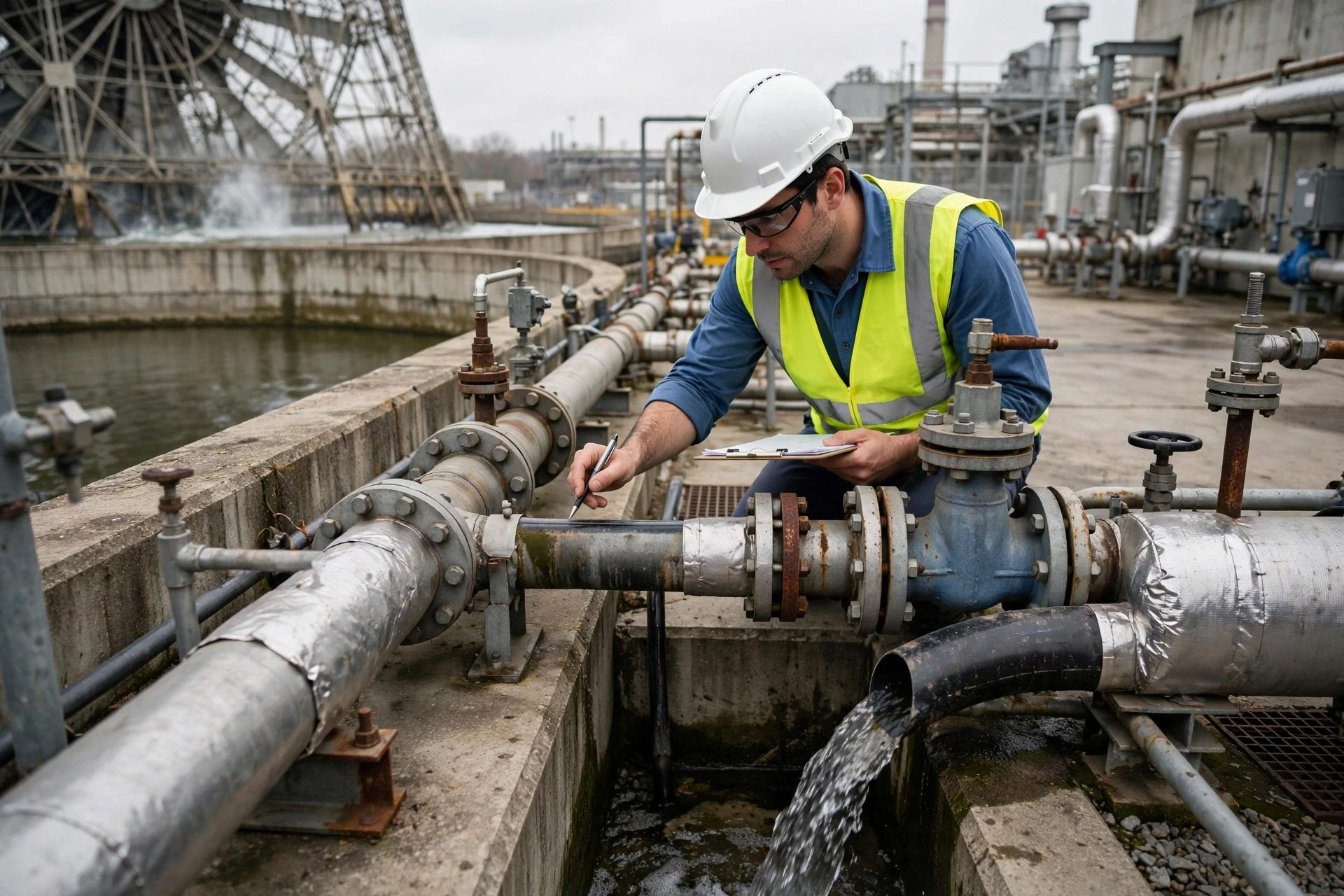
Start with a physical walk-through, not a files-only review. List cooling towers, boilers, closed loops, paint booths, and wastewater discharge points. Note where each one sends water: to a sewer, a receiving stream, or a hauler. The systems you skip in this inventory are the ones that fail audits later. Many Ohio plants bring in outside support for this step; engineer-led providers such as Hoffman Water map cooling tower and boiler systems as part of their site review.
Attach permit conditions and stormwater plans to each system
Every system needs its governing document next to it on the map. Discharges to a stream fall under NPDES permit limits; runoff from yards and roof drains belongs in your industrial stormwater SWPPP. Write the control limits for pH, metals, and flow directly on the inventory sheet so operators see the number before they open a valve.
Control limits are the numeric ranges your systems must stay inside to meet permit and equipment requirements. Common industrial water treatment control limits include cooling tower conductivity, inhibitor residuals, pH, cycles of concentration, and blowdown control setpoints, plus boiler water treatment parameters such as hardness, alkalinity, and dissolved oxygen.
Define measurable limits for each system
Start from your permits, then your equipment manuals. A cooling tower may need conductivity capped at a set number of micromhos; a boiler needs hardness near zero; a discharge needs pH inside its NPDES permit limits. Write one limit line per parameter, per system. Engineers who set these ranges from actual system chemistry, as Hoffman Water does on site, avoid the guesswork of generic targets.
Turn readings into a routine that produces usable records
Decide who tests, what, how often, and with what method. Log every result with date, time, and tester initials, whether on paper or in software. When a reading breaks a limit, a corrective action note should show what you did and when. Auditors read consistency, not perfection. A clean, complete log proves the program works even on the day a number drifts out of range.
Step 3: Apply the Treatment That Fixes Compliance and Cuts Cost
The right treatment program holds discharge within your NPDES permit limits while lowering chemical, water, and energy spend. The best options do both at once:
- Blowdown control and higher cycles of concentration in cooling towers cut water use and keep discharge parameters stable.
- Solid chemistry programs remove hazardous liquid chemical handling and simplify records.
- Paint detackification chemistry keeps booth wastewater within limits and reduces sludge hauling.
An engineer-led review matches chemistry to your actual permit and equipment, which is how industrial water treatment solutions deliver both outcomes. Ohio facilities using paint booths can explore dedicated paint detackification programs for booth-specific chemistry.
Corrective action when a limit is missed
Treat any exceedance like the 4 a.m. discharge report example: document it, notify the agency if the permit requires it, and correct the cause within the deadline. Then reset control limits and record the fix. Written corrective action turns one bad number into defensible compliance documentation.
Step 4: Document, Audit, and Keep the Program Current
A compliance program only holds up if you can prove it. Inspectors and auditors ask for records, not intentions.
Build the audit trail
Log test results, chemical feed checks, blowdown control settings, and any corrective action the same day it happens. Each entry should show the date, the reading, the person who took it, and what was done next. Keep permits, training records, and calibration logs in one indexed place so a water treatment program audit takes hours, not weeks.
Know when to revise the program
Update the program when any of these triggers hit:
- A permit renewal or a change in NPDES permit limits
- New equipment, production volume, or chemicals on site
- A failed test, spill, or repeated exceedance
- Staff turnover in a key operator role
- New EPA NPDES permit conditions or rules
Review the whole program at least once a year, even if nothing changed.
Building a program that survives the 4 a.m. report takes engineer-led support. Talk to the team at Hoffman Water about your Ohio facility, and start mapping your compliance program this week.
Frequently Asked Questions
Q1: What industrial water treatment solutions improve compliance and efficiency?
Blowdown control with higher cycles of concentration, solid chemistry programs, and paint detackification chemistry. Each holds discharge within NPDES permit limits while cutting water, chemical, and hauling costs.
Q2: How often should control limits be reviewed?
Check them at every permit renewal, equipment change, or exceedance, and review the full program at least once a year even when nothing changed.
Q3: What records do auditors expect?
Dated test results, tester initials, chemical feed checks, blowdown settings, calibration logs, and corrective action notes, all kept in one indexed place.
Q4: What triggers a corrective action?
Any reading outside a control limit. Document it, notify the agency if your permit requires it, fix the cause, and record the fix.
Conclusion
An industrial water compliance program works when it follows one sequence: map every system, set control limits, test on a routine, apply the right treatment, and document the results. Engineered this way, your records answer an auditor before they ask.